This module is used to represent inference results. Built-in supported types are ROOT, CLASSIFICATION, DETECTION and SEGMENTATION. Custom types can be integrated by deriving from InferResultImplBase and passing the shared pointer to the pimpl constructor; the CUSTOM_RESULT_* enum values are NOT accepted by the type-enum constructor below.
More...
#include <vart_inferresult.hpp>
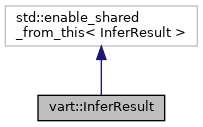
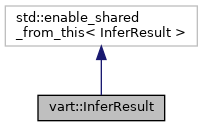
Public Member Functions | |
| InferResult ()=delete | |
| InferResult (InferResultType infer_res_type) | |
| InferResult() - Constructor for using supported infer result type implementations. More... | |
| InferResult (std::shared_ptr< InferResultImplBase > ptr) | |
| InferResult() - Constructor for using user defined implementation. More... | |
| const std::shared_ptr< InferResultImplBase > & | get_pimpl_handle () const |
| get_pimpl_handle() - Gives pointer to implementation class. More... | |
| void | transform (InferResScaleInfo &info) |
| transform() - Transforms the infer results to the input frame resolution. More... | |
| InferResultData * | get_infer_result () |
| get_infer_result() - Get the inference result data held by this node. More... | |
| void | add_child (std::shared_ptr< InferResult > child) |
| add_child() - Add a child to this infer result node. More... | |
| void | add_children (std::vector< std::shared_ptr< InferResult >> arg_children) |
| add_children() - Add all children at once. More... | |
| std::vector< std::shared_ptr< InferResult > > | get_children () |
| get_children() - Returns all children of the node. More... | |
| std::shared_ptr< InferResult > | get_parent () |
| get_parent() - Returns parent of the given inference result node. More... | |
| std::shared_ptr< InferResult > | get_root () |
| get_root() - Returns root of the given inference result node. More... | |
| void | traverse (const std::function< void(std::shared_ptr< InferResult >, void *)> &callback, TraversalOrder order, void *user_data) |
| traverse() - Traverse through the tree nodes in a given order. More... | |
| size_t | get_depth () |
| get_depth() - Returns depth of the current node More... | |
Detailed Description
This module is used to represent inference results. Built-in supported types are ROOT, CLASSIFICATION, DETECTION and SEGMENTATION. Custom types can be integrated by deriving from InferResultImplBase and passing the shared pointer to the pimpl constructor; the CUSTOM_RESULT_* enum values are NOT accepted by the type-enum constructor below.
- See also
- InferResultImplBase
Constructor & Destructor Documentation
◆ InferResult() [1/3]
|
delete |
◆ InferResult() [2/3]
| vart::InferResult::InferResult | ( | InferResultType | infer_res_type | ) |
InferResult() - Constructor for using supported infer result type implementations.
- Parameters
-
[in] infer_res_type Enum class to specify which implementation to instantiate. Accepted values are ROOT,CLASSIFICATION,DETECTION,SEGMENTATION. SeeInferResultTypefor all supported types.
- Exceptions
-
std::invalid_argument If infer_res_typeisCUSTOM_RESULT_1,CUSTOM_RESULT_2orCUSTOM_RESULT_3— those must be supplied via the pimpl constructor below, not this factory.
◆ InferResult() [3/3]
| vart::InferResult::InferResult | ( | std::shared_ptr< InferResultImplBase > | ptr | ) |
InferResult() - Constructor for using user defined implementation.
- Parameters
-
[in] ptr Pointer to user's implementation instance. Must be non-null; the constructor stores it as the pimpl and subsequent method calls dereference it without an additional null check.
Member Function Documentation
◆ add_child()
| void vart::InferResult::add_child | ( | std::shared_ptr< InferResult > | child | ) |
add_child() - Add a child to this infer result node.
- Parameters
-
[in] child Child node to be added
User can use this method to build cascade infer result tree by adding child nodes to the previous inference level starting with a dummy root node.
◆ add_children()
| void vart::InferResult::add_children | ( | std::vector< std::shared_ptr< InferResult >> | arg_children | ) |
add_children() - Add all children at once.
- Parameters
-
[in] arg_children Child nodes to install. The internal children vector is overwritten with this list (it does NOT append). Use add_child()repeatedly if you want to grow the list instead.
Each entry has its parent updated to this node.
◆ get_children()
| std::vector<std::shared_ptr<InferResult> > vart::InferResult::get_children | ( | ) |
get_children() - Returns all children of the node.
- Returns
- vector of child nodes.
◆ get_depth()
| size_t vart::InferResult::get_depth | ( | ) |
get_depth() - Returns depth of the current node
- Returns
- Depth of the current node.
◆ get_infer_result()
| InferResultData* vart::InferResult::get_infer_result | ( | ) |
get_infer_result() - Get the inference result data held by this node.
- Returns
- Inference result object for the requested frame.
◆ get_parent()
| std::shared_ptr<InferResult> vart::InferResult::get_parent | ( | ) |
get_parent() - Returns parent of the given inference result node.
- Returns
- Parent result node.
◆ get_pimpl_handle()
| const std::shared_ptr<InferResultImplBase>& vart::InferResult::get_pimpl_handle | ( | ) | const |
get_pimpl_handle() - Gives pointer to implementation class.
- Returns
- Returns a constant reference of pointer to implementation class.
◆ get_root()
| std::shared_ptr<InferResult> vart::InferResult::get_root | ( | ) |
get_root() - Returns root of the given inference result node.
- Returns
- Root result node.
◆ transform()
| void vart::InferResult::transform | ( | InferResScaleInfo & | info | ) |
transform() - Transforms the infer results to the input frame resolution.
- Parameters
-
[in] info Resolution information to be used for transformation (see InferResScaleInfo).
Typically, in video pipelines, the original input resolution differs from the resolution of the input to the machine learning model. If we have inference results, like detection from may be 200x200 resolution (input resolution to ML model) and if we want to transform the bounding box results to the original input resolution, which may be 1920x1080. In such cases, one can use this function to transform the bounding box dimensions in the infer results to the resolution of input image.
◆ traverse()
| void vart::InferResult::traverse | ( | const std::function< void(std::shared_ptr< InferResult >, void *)> & | callback, |
| TraversalOrder | order, | ||
| void * | user_data | ||
| ) |
traverse() - Traverse through the tree nodes in a given order.
- Parameters
-
[in] callback User callback function to be called for each node as per the order chosen. [in] order Order in which the tree nodes to be traversed: PREORDER:visit each node once before recursing into children.POSTORDER:visit each node once after recursing into children.INORDER:visit the current node once per child edge while recursing. For n-ary trees this means a node with k children is visited k times (and a leaf 0 times); this is NOT the classical binary-tree in-order traversal.
[in] user_data User data to be passed to the callback function.
The documentation for this class was generated from the following file: