Mixed Precision Compilation#
Overview#
When quantizing models to INT8, certain operations lose unacceptable accuracy and must fall back to the CPU for execution in FP32. This creates performance bottlenecks from data transfer overhead between the NPU and CPU, and increases power consumption.
Mixed precision compilation enables the AMD Vitis™ AI compiler to execute models with both quantized (VINT8) and floating-point operations entirely on the NPU. The compiler automatically converts FP32 sections excluded from quantization to BF16 or FP16, eliminating CPU fallback while preserving model accuracy.
By keeping all operations on the NPU, mixed precision reduces latency from data transfers, decreases memory bandwidth and model footprint compared to FP32, and improves power efficiency.
Prerequisites#
Before using mixed precision compilation, your model must be quantized with AMD Quark using the VINT8 configuration.
To exclude accuracy-sensitive operations from quantization, use the
subgraphs_to_exclude configuration option. This option targets a
connected sequence of nodes forming a logical processing block, such as
a post-processing or NMS subgraph. The excluded subgraph is compiled to
BF16 or FP16 by the Vitis AI compiler and runs entirely on the NPU,
avoiding CPU fallback.
Note
AMD Quark also provides an nodes_to_exclude option, which targets
individual named nodes rather than connected subgraphs. For mixed
precision compilation workflows, use subgraphs_to_exclude to
exclude entire functional blocks. Use nodes_to_exclude only when
a single isolated node must be excluded.
For detailed Quark setup instructions and the full list of supported configuration options in Vitis AI, see Model Quantization.
Use Cases#
Mixed precision compilation is designed for models where full INT8 quantization is insufficient. Use this feature when you encounter any of the following scenarios:
Quantization Degrades Accuracy#
Your model experiences unacceptable accuracy loss when fully quantized to INT8. Attention mechanisms, layer normalization, and softmax operations often show significant degradation in INT8 precision. Transformer-based models such as BERT, GPT, and Vision Transformers typically lose accuracy with full quantization, as do multi-modal architectures like CLIP and Flamingo. Profiling might reveal specific layers that require higher precision for acceptable model performance.
Use Quark’s exclude-nodes to keep accuracy-sensitive operations in FP32, then compile with mixed precision to convert them to BF16/FP16 on the NPU.
CPU Offloading Creates Bottlenecks#
Your deployment cannot tolerate the latency or throughput impact of CPU fallback. Profiling might show significant time spent transferring data between NPU and CPU. Real-time inference requirements in autonomous vehicles, robotics, and live video analytics are sensitive to CPU offloading overhead. Throughput-sensitive workloads and batch processing pipelines where the CPU limits performance often see improvements from keeping all operations on the NPU.
Mixed precision eliminates data transfer overhead by running all operations on the NPU while maintaining acceptable accuracy.
Resource-Constrained Deployments#
Your deployment environment benefits from reduced memory and power consumption. Edge devices with limited memory bandwidth, battery-powered applications, and data center deployments optimizing for performance-per-watt benefit from mixed precision. BF16/FP16 operations consume half the memory of FP32 while running on the NPU’s power-efficient hardware.
When NOT to Use Mixed Precision#
Skip mixed precision compilation if your model achieves target accuracy with full INT8 quantization, or if CPU fallback overhead is acceptable for your latency requirements. When experimenting with quantization strategies, start with full INT8 first, then use mixed precision only if necessary.
Basic Configuration#
No configuration required. The compiler automatically converts FP32 operations to BF16.
Add the following to your Vitis AI Config:
{
  "enable_f32_to_bf16_conversion": false,
  "enable_f32_to_f16_conversion": true
}
The following sections provide comprehensive configuration reference for all mixed precision patterns and flags.
Configuration Reference#
Base Flags#
Flag |
Type |
Model Type and When to Use |
|---|---|---|
|
boolean |
For VINT8 + FP32 mixed models (quantized with excluded sections remaining in FP32). Default behavior. The compiler converts excluded FP32 sections to BF16 during compilation. Use for balanced performance and accuracy. |
|
boolean |
For VINT8 + FP32 mixed models (quantized with excluded sections remaining in FP32). The compiler converts excluded FP32 sections to FP16 during compilation. Use when BF16 shows excessive accuracy loss on NPU or for precision-sensitive tasks (depth estimation, regression). Not used for models already fully converted to FP16 in Quark. |
|
string |
For mixed models with FP head or middle sections (Patterns 2, 3, 4). Use when your VINT8 + FP32 model has floating-point operations at the beginning (FP HEAD) or sandwich structure (FP-VINT8-FP). Enables compiler to recognize power-of-two quantization kernels. |
|
string |
For mixed models with three or more alternating sections (Patterns 4, 5, 6), except |
Specialized Flags#
For Models with Quantized VINT8 GEMM Operations#
Add the following configuration:
{
  "fe_experiment": "convert-int8-matmul-to-conv=0",
  "enable-int8-gemm": 1
}
Understanding how the compiler processes mixed precision models helps you choose the right configuration for your use case.
How It Works#
The mixed precision compilation workflow begins with an ONNX model quantized using AMD Quark in VINT8 configuration with excluded FP32 or FP16 sections.
During compilation, the Vitis AI compiler:
Converts FP32 sections to BF16 or FP16 based on configuration flags
Automatically inserts cast operations to manage precision transitions between INT8 and BF16/FP16
Optimizes the model for full NPU execution
The compiled model executes entirely on the NPU with automatic precision transitions, eliminating CPU fallback overhead and data transfers. Using 16-bit precision instead of 32-bit for non-quantized sections reduces memory footprint and improves latency, throughput, and power efficiency.
Mixed VINT8 and Floating Point Models#
Vitis AI supports mixed-precision models that combine floating-point (fp) and 8-bit integer (vint8) layers in alternating patterns such as fp -> vint8 -> fp -> vint8 or vint8 -> fp -> vint8 -> fp. The compiler automatically converts floating-point layers to fp16 or bf16.
In a mixed-precision model, transitions between vint8 and floating-point regions follow a specific pattern:
Transition |
Operation |
|---|---|
Exiting a vint8 region, entering an fp region |
Dequantize (DQ) |
Exiting an fp region, entering a vint8 region |
Quantize (Q) |
Floating-point operations between vint8 regions always appear in the following structure:
... vint8 -> DQ -> [fp operation(s)] -> Q -> vint8 ...
When the compiler encounters a DQ -> [operations] -> Q sequence, it cannot easily determine whether the operations represent a vint8 quantized pattern (a single quantized operation with its surrounding DQ/Q wrappers) or an intentional floating-point island (a group of operations deliberately kept in floating-point precision). Both cases look structurally identical to the compiler.
The compiler applies a simple rule to resolve the ambiguity: A valid vint8 quantized pattern contains exactly one ONNX-level operation between a DQ and Q pair. Based on this rule, a single ONNX operation between DQ and Q is treated as vint8 quantized, while more than one ONNX operation is treated as a floating-point island.
The operation count is performed at the ONNX level, not at the internal TOSA IR level. This is important because some single ONNX operations (such as Softmax) are decomposed into multiple TOSA operations internally, and the compiler needs to correctly recognize these as a single vint8 pattern.
As a result: If an intentional floating-point island contains only a single ONNX operation between DQ and Q, the compiler incorrectly classifies it as a vint8 quantized pattern. There is currently no way to distinguish this case from a genuinely quantized operation.
Ensure that intentional floating-point islands contain more than one ONNX operation so the compiler can correctly identify them.
Pattern Reference#
The compiler supports six distinct graph patterns for mixed precision models. All patterns support both BF16 and FP16 variants based on configuration flags. The following table summarizes the six supported patterns:
Pattern Summary#
# |
Structure |
Required Config |
Input |
Output |
|---|---|---|---|---|
1 |
VINT8 HEAD -> FP TAIL |
Default (BF16) or FP16 flags |
int8 |
bf16/fp16, fp32 |
2 |
FP HEAD -> VINT8 TAIL |
“fe_experiment”: “match-power-of-two-quant-kernel=1” |
bf16/fp16, fp32 |
int8 |
3 |
FP HEAD -> VINT8 MID -> FP TAIL |
“fe_experiment”: “match-power-of-two-quant-kernel=1” |
bf16/fp16, fp32 |
bf16/fp16, fp32 |
4 |
VINT8 HEAD -> FP MID -> VINT8 TAIL |
“fe_experiment”: “match-power-of-two-quant-kernel=1 mark-multi-op-fp-islands=1” |
int8 |
int8 |
5 |
FP HEAD -> VINT8 MID -> FP MID -> VINT8 TAIL |
“fe_experiment”: “match-power-of-two-quant-kernel=1 mark-multi-op-fp-islands=1” |
bf16/fp16, fp32 |
bf16/fp16, fp32 |
6 |
VINT8 HEAD -> FP MID -> VINT8 MID -> FP TAIL |
“fe_experiment”: “match-power-of-two-quant-kernel=1 mark-multi-op-fp-islands=1” |
int8 |
bf16/fp16, fp32 |
Pattern 1: VINT8 HEAD -> FP TAIL#
Structure#
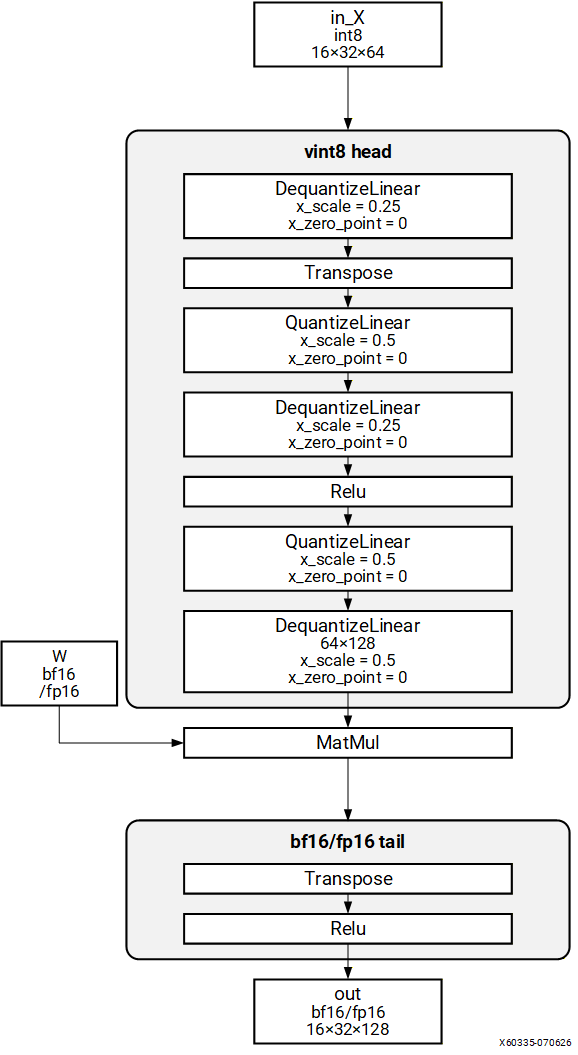
Description#
Quantized model with VINT8 operations at the head and FP32 operations at the tail. The compiler replaces the FP32 tail on the CPU with a BF16 or FP16 equivalent tail on the NPU.
BF16 Variant Configuration#
Default behavior, no special configuration required.
Input types: int8
Output types: bf16, fp32 (cast or converted from bf16)
FP16 Variant Configuration#
{
  "enable_f32_to_bf16_conversion": false,
  "enable_f32_to_f16_conversion": true
}
Input types: int8
Output types: fp16, fp32 (cast or converted from fp16)
Pattern 2: FP HEAD -> VINT8 TAIL#
Structure#
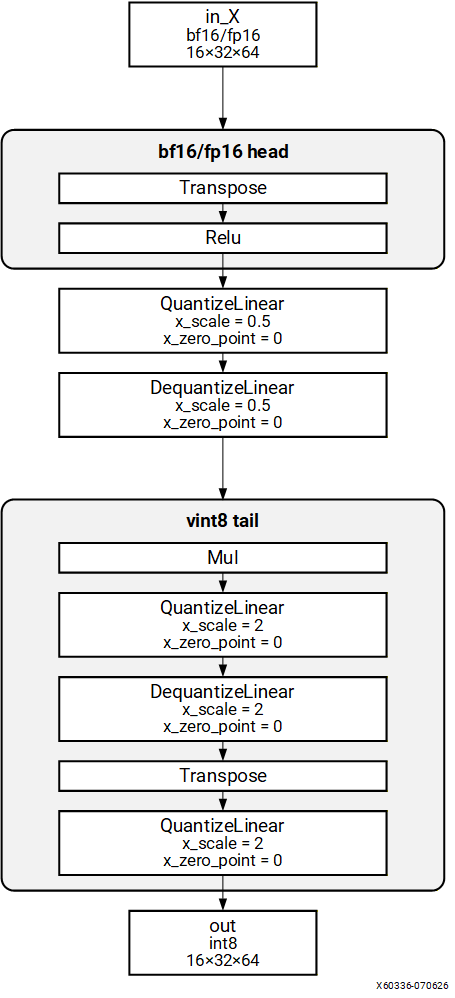
Description#
Quantized model with FP32 operations at the head and VINT8 operations at the tail. The compiler replaces the FP32 head on the CPU with a BF16 or FP16 equivalent head on the NPU.
BF16 Variant Configuration#
{
  "fe_experiment": "match-power-of-two-quant-kernel=1"
}
Input types: bf16, fp32 (cast or converted to bf16), fp16 (cast or converted to bf16)
Output types: int8
FP16 Variant Configuration#
{
  "fe_experiment": "match-power-of-two-quant-kernel=1",
  "enable_f32_to_bf16_conversion": false,
  "enable_f32_to_f16_conversion": true
}
Input types: fp16, fp32 (cast or converted to fp16)
Output types: int8
Pattern 3: FP HEAD -> VINT8 MIDDLE -> FP TAIL#
Structure#
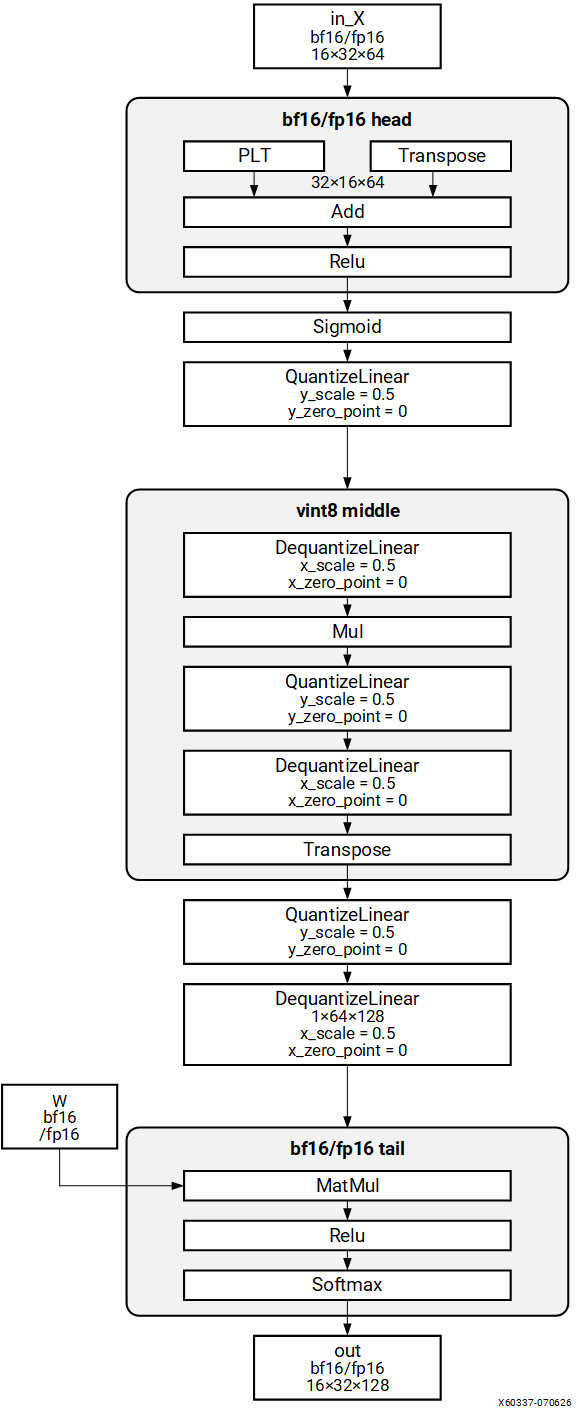
Description#
Quantized model with FP32 operations at the head, VINT8 operations in the middle, and FP32 operations at the tail. The compiler replaces the FP32 head and tail on the CPU with BF16 or FP16 equivalents on the NPU.
BF16 Variant Configuration#
{
  "fe_experiment": "match-power-of-two-quant-kernel=1"
}
Input types: bf16, fp32 (cast or converted to bf16), fp16 (cast or converted to bf16)
Output types: bf16, fp32 (cast or converted from bf16), fp16 (cast or converted from bf16)
FP16 Variant Configuration#
{
  "fe_experiment": "match-power-of-two-quant-kernel=1",
  "enable_f32_to_bf16_conversion": false,
  "enable_f32_to_f16_conversion": true
}
Input types: fp16, fp32 (cast or converted to fp16)
Output types: fp16, fp32 (cast or converted from fp16)
Pattern 4: VINT8 HEAD -> FP MIDDLE -> VINT8 TAIL#
Structure#
In the following diagram, Q denotes QuantizeLinear, DQ denotes
DequantizeLinear, and Q/DQ denotes a QuantizeLinear immediately followed
by a DequantizeLinear.
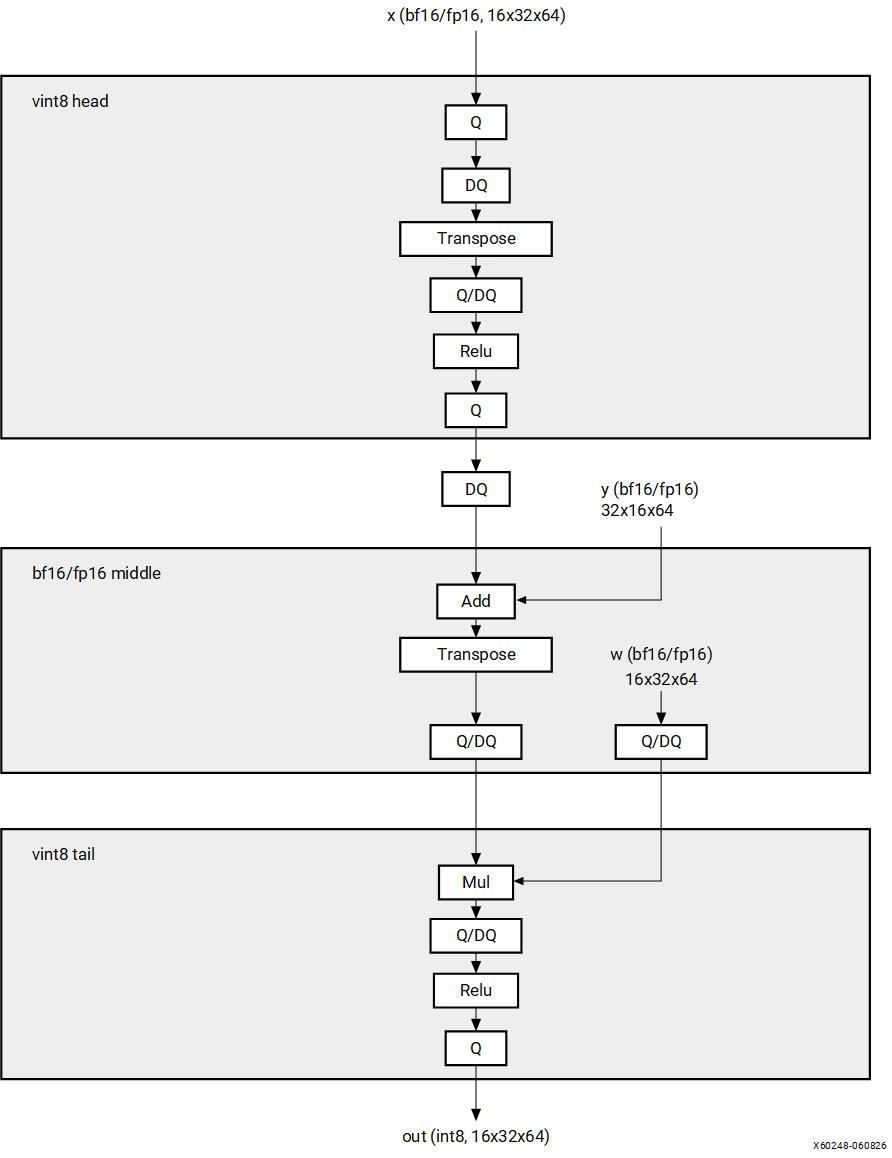
Description#
Quantized model with VINT8 operations at the head, FP32 operations in the middle, and VINT8 operations at the tail. The compiler replaces the FP32 middle section on the CPU with a BF16 or FP16 equivalent middle section on the NPU.
BF16 Variant Configuration#
{
  "fe_experiment": "match-power-of-two-quant-kernel=1 mark-multi-op-fp-islands=1"
}
Input types: int8
Output types: int8
FP16 Variant Configuration#
{
  "fe_experiment": "match-power-of-two-quant-kernel=1 mark-multi-op-fp-islands=1",
  "enable_f32_to_bf16_conversion": false,
  "enable_f32_to_f16_conversion": true
}
Input types: int8
Output types: int8
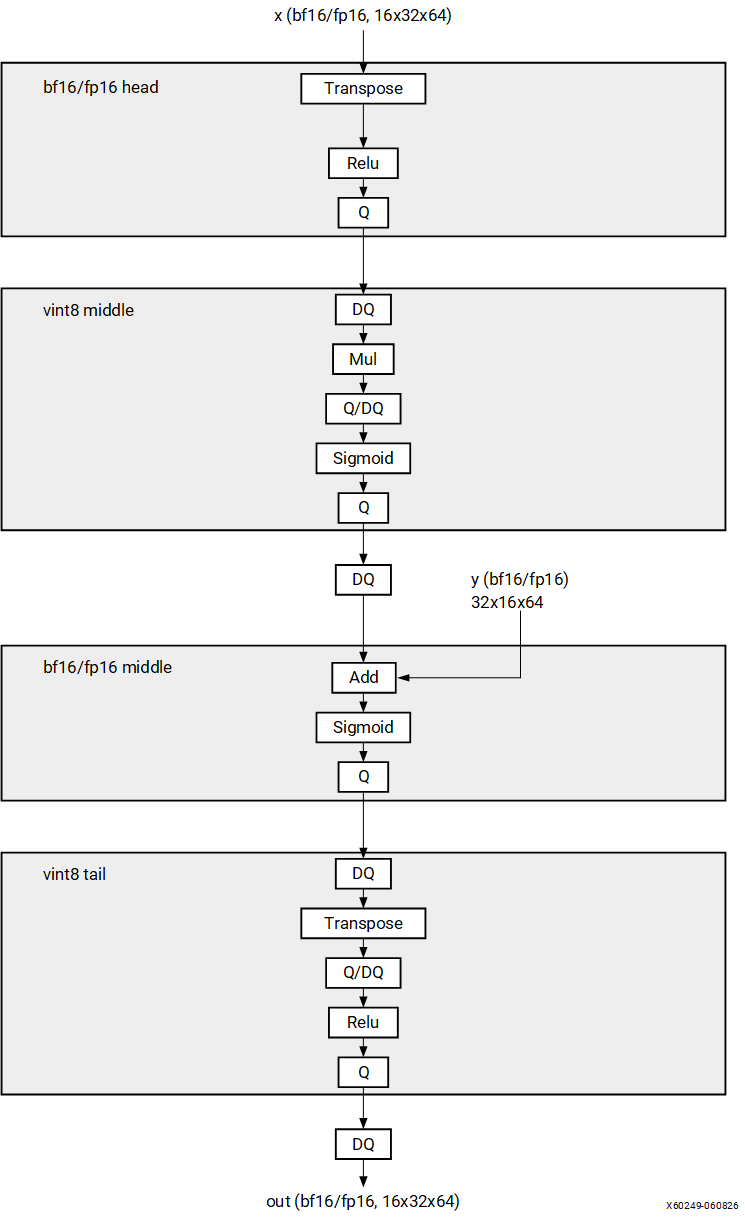
Pattern 5: FP HEAD -> VINT8 MIDDLE -> FP MIDDLE -> VINT8 TAIL#
Structure#
In the following diagram, Q denotes QuantizeLinear, DQ denotes
DequantizeLinear, and Q/DQ denotes a QuantizeLinear immediately followed
by a DequantizeLinear.
Description#
Quantized model with FP32 operations at the head, VINT8 operations in the middle(1), FP32 operations in the middle(2), and VINT8 operations at the tail. The compiler replaces the FP32 sections on the CPU with BF16 or FP16 equivalents on the NPU.
BF16 Variant Configuration#
{
  "fe_experiment": "match-power-of-two-quant-kernel=1 mark-multi-op-fp-islands=1"
}
Input types: bf16, fp32 (cast or converted to bf16), fp16 (cast or converted to bf16)
Output types: bf16, fp32 (cast or converted from bf16), fp16 (cast or converted from bf16)
FP16 Variant Configuration#
{
  "fe_experiment": "match-power-of-two-quant-kernel=1 mark-multi-op-fp-islands=1",
  "enable_f32_to_bf16_conversion": false,
  "enable_f32_to_f16_conversion": true
}
Input types: fp16, fp32 (cast or converted to fp16)
Output types: fp16, fp32 (cast or converted from fp16)
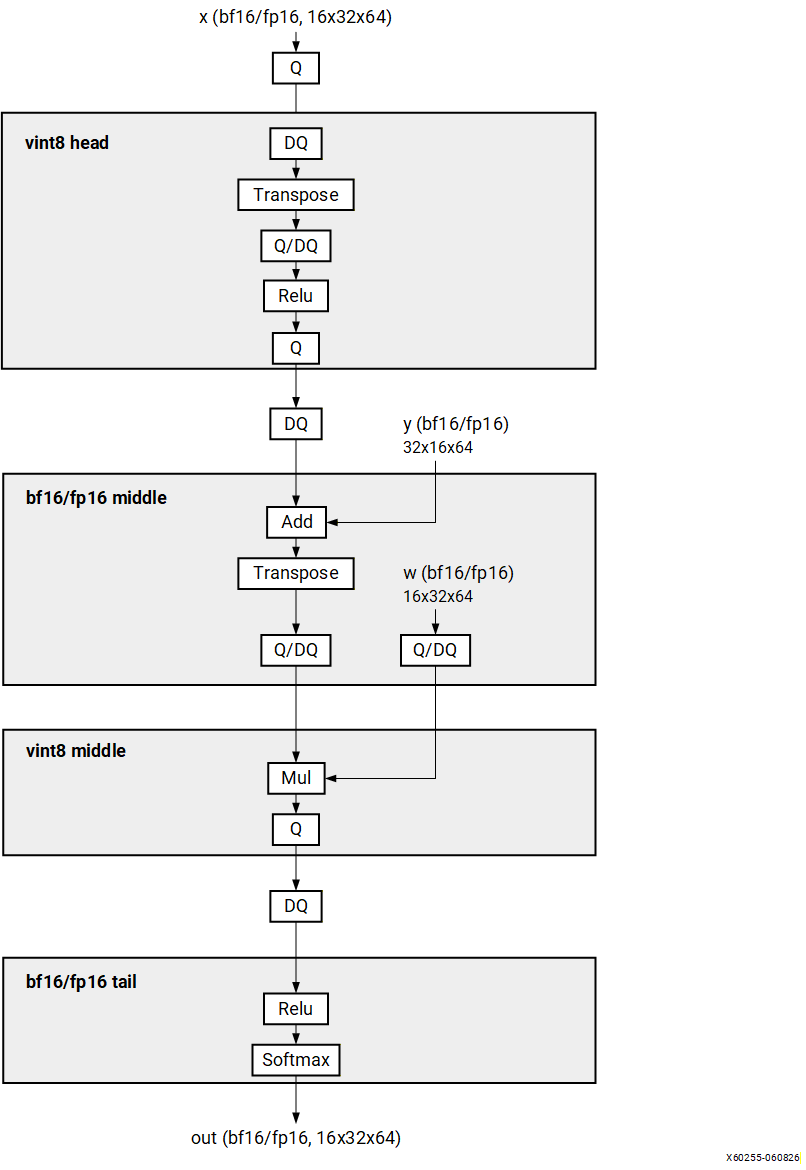
Pattern 6: VINT8 HEAD -> FP MIDDLE -> VINT8 MIDDLE -> FP TAIL#
Structure#
In the following diagram, Q denotes QuantizeLinear, DQ denotes
DequantizeLinear, and Q/DQ denotes a QuantizeLinear immediately followed
by a DequantizeLinear.
Description#
Quantized model with VINT8 operations at the head, FP32 operations in the middle(1), VINT8 operations in the middle(2), and FP32 operations at the tail. The compiler replaces the FP32 sections on the CPU with BF16 or FP16 equivalents on the NPU.
BF16 Variant Configuration#
{
  "fe_experiment": "match-power-of-two-quant-kernel=1 mark-multi-op-fp-islands=1"
}
Input types: int8
Output types: bf16, fp32 (cast or converted from bf16)
FP16 Variant Configuration#
{
  "fe_experiment": "match-power-of-two-quant-kernel=1 mark-multi-op-fp-islands=1",
  "enable_f32_to_bf16_conversion": false,
  "enable_f32_to_f16_conversion": true
}
Input types: int8
Output types: fp16, fp32 (cast or converted from fp16)
Compilation Report#
After compilation, the compiler generates a report file named final-vaiml-pass-summary.txt in the directory containing the compiled model (cache_dir/cache_key). This report shows the compiled model data type.
--------- Final Summary of VAIML Pass ----------
OS: Linux X64
VAIP commit: a4198fae337079ee501a4201667c2acbb5d4b69d
Model: yolov8m_tail_non_quant.onnx
Model signature: e5ada2d7e7da7a9f0459d22717e11935
Device: ve2
Model data type: float32 and int8 quantized
Device data type: float16 and int8
Number of operators in the model: 1182
GOPs of the model: 84.2089
Number of operators supported by VAIML: 1182 (100.000%)
GOPs supported by VAIML: 84.209 (100.000%)
Number of subgraphs supported by VAIML: 1
  NOTE: Number of subgraph supported by VAIML does not include subgraphs below GOPs% threshold.
Number of operators offloaded by VAIML: 1182 (100.000%)
GOPs offloaded by VAIML: 84.209 (100.000%)
Number of subgraphs offloaded by VAIML: 1
Number of subgraphs with compilation errors (fall back to CPU): 0
Number of subgraphs below 10% GOPs threshold (fall back to CPU): 0
Number of subgraphs above max number of subgraphs allowed(7): 0 (fall back to CPU)